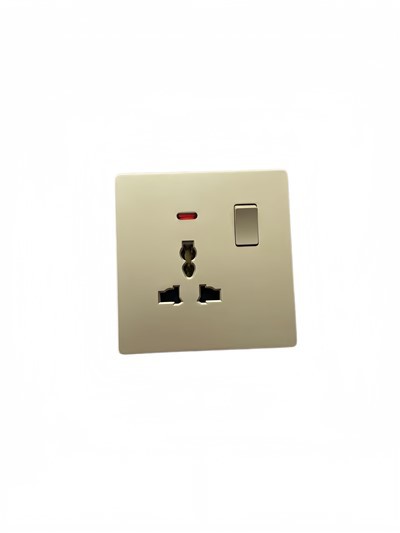
Wall switch and socket frames are essential components of a building's electrical system, and their frame implementation standards are directly related to electrical safety and reliability.
Current Chinese standards are primarily based on national standards GB/T 16915.1-2014, "Switches for Household and Similar Fixed Electrical Installations - Part 1: General Requirements," and GB/T 2099.1-2021, "Plugs and Sockets for Household and Similar Purposes - Part 1: General Requirements," which set clear requirements for frame materials, structural design, and safety performance.
In terms of materials, frames must be made of engineering plastics (such as PC polycarbonate) with a flame retardancy rating of at least V-0 to ensure they are resistant to combustion under high temperatures or short-circuit conditions. Metal components (such as grounding terminals) must pass salt spray testing and demonstrate corrosion resistance for at least 96 hours without oxidation. Dimensional tolerances must be strictly controlled within ±0.2mm to ensure compatibility with components such as circuit breakers and panels.
In terms of structural design, the standard stipulates that the frame must have an anti-electric shock door, and the single-hole insertion force must be greater than 5N to prevent accidental child contact. The temperature rise of the current-carrying parts of the socket must not exceed 45K (at an ambient temperature of 25°C). The mechanical life of the switch must reach at least 10,000 cycles, and the electrical life must be at least 4,000 cycles. Furthermore, the ground continuity resistance must be less than 0.05Ω to ensure effective leakage protection.
Internationally, the EU EN 60669-1 and IEC 60884-1 standards have more stringent requirements for fire protection (e.g., no combustion in a glow-wire test at 850°C) and electromagnetic compatibility (EMC). The US UL 498 focuses on impact testing (no damage after a 1-meter drop) and creepage distance (≥3mm).
Compliance with these standards is not only a regulatory requirement but also a technical foundation for protecting user life and property. Manufacturers must obtain testing from CNAS-accredited laboratories and indicate the implementation standard number on the product nameplate to ensure compliance throughout the product lifecycle.