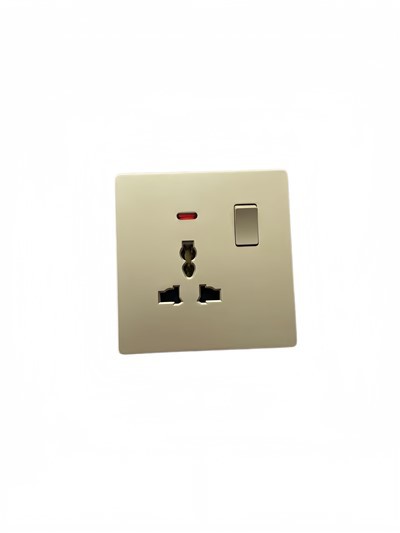
Plastic wall sockets are an indispensable component of modern electrical installations, and their material selection directly impacts their safety, durability, and user experience. The mainstream plastic wall sockets currently on the market are made from the following materials:
1. ABS (Acrylonitrile-Butadiene-Styrene)
ABS plastic is one of the most commonly used materials for wall sockets, offering excellent overall performance. Its high strength and toughness allow it to withstand certain impacts without cracking. It also offers excellent heat resistance and electrical insulation, meeting electrical safety standards. Furthermore, ABS is easy to process and mold to meet diverse design requirements, and its smooth surface makes it suitable for painting or electroplating, enhancing the product's aesthetics.
2. PC (Polycarbonate)
PC plastic is widely used in high-end sockets due to its exceptionally high heat and impact resistance. Its high heat deflection temperature allows it to withstand the transient high temperatures generated by short circuits or overloads, effectively reducing the risk of fire. PC also offers excellent flame retardancy, meeting international fire safety standards such as UL94 V-0, further enhancing socket safety. Furthermore, PC offers high transparency, and some high-end sockets feature a translucent design, making it easier to observe the internal structure.
3. PBT (Polybutylene Terephthalate)
PBT is a high-performance engineering plastic with excellent electrical insulation and chemical resistance, making it suitable for sockets used in humid or harsh environments. It offers excellent dimensional stability, resists deformation due to temperature fluctuations, and exhibits excellent flame retardancy, making it commonly used in industrial-grade or special-purpose sockets.
4. Other Ancillary Materials
In addition to the main plastic, the conductive components within the socket are typically made of phosphor bronze or brass to ensure good conductivity. The contact areas of the socket may be nickel- or gold-plated for improved wear resistance and oxidation resistance. The connection between the outer shell and the internal structure typically relies on precision injection molding of high-strength plastic to ensure overall structural stability.
In summary, the material selection for plastic wall sockets must balance safety, durability, and functionality. ABS and PC are currently the most mainstream solutions, while high-performance materials such as PBT are suitable for specialized applications. In the future, with the advancement of materials science, more environmentally friendly and safer plastic materials will further optimize the performance of socket products.